Kitchen Remodeling Cost: Where Your Money Goes
KEY TAKEAWAYS
A kitchen remodel in Marin and Sonoma typically runs $40,000 to $65,000 for a cosmetic update and $120,000 to $200,000 or more for a full gut renovation, with cabinets and labor usually claiming the largest share.
Cabinets and hardware are the single biggest line item in most kitchens, often 25 to 35 percent of the total, which makes them the first place to set your priorities.
Plumbing and electrical costs climb sharply the moment you move a sink, range, or wall, so layout decisions drive budget more than finishes do.
Locking in a budget, timeline, and materials plan before any demolition begins is the most reliable way to keep a kitchen remodel from drifting over cost.
Kitchen remodeling cost is the total of five major spending categories – cabinets, countertops, plumbing and electrical, labor, and finish selections – and understanding how each one behaves is the difference between a budget you control and one that controls you. Most cost articles hand you a range and stop there. This one shows you where the money actually goes, so you can decide what matters and what doesn't before you spend a dollar. If you want the full picture of scope and options first, our kitchen remodeling services page lays out what a complete project includes.
We've been remodeling kitchens in Marin and Sonoma for over 40 years, which means we've opened a lot of walls in homes built in the 1950s, 60s, and 70s. That history matters here, because the costs you can see on a quote are rarely the ones that surprise people. The ones behind the plaster are. A realistic kitchen remodel in this region starts around $40,000 to $65,000 for a cosmetic refresh and climbs to $120,000 to $200,000 or more for a full gut. Where you land inside that range depends almost entirely on the five categories below.
Cabinets and Hardware: The Largest Line Item
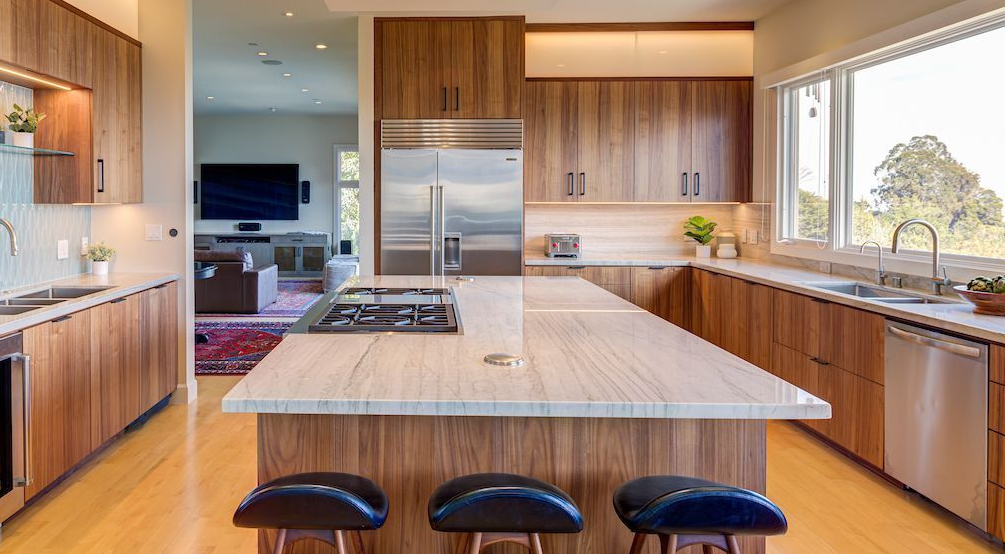
Cabinets are usually the biggest single cost in a kitchen, frequently 25 to 35 percent of the total. That's because they're part furniture, part structure, and part labor all at once. The price gap between stock, semi-custom, and full-custom cabinetry is wide, and it's where the most money is won or lost.
Stock cabinets come in fixed sizes and ship fast. Semi-custom lets you adjust dimensions and finishes within a set system. Full-custom is built to your exact space and is the only real option when a kitchen has odd angles, tall ceilings, or original walls that aren't square – which describes a lot of older Marin and Sonoma homes. The further you move toward custom, the more the cost reflects both the materials and the skilled labor to fit them.
Hardware seems minor until you count it. Soft-close hinges, full-extension drawer slides, and pull-out organizers add up across 20 or 30 doors and drawers. None of it is required, but each piece is a small decision that compounds. Decide early which functions you actually use daily and spend there first.
Countertops: Material Drives the Spread
Countertops are the second category where the material you pick swings the price the most. Square footage matters, but the surface itself matters more. The same kitchen can cost dramatically different amounts depending on whether you choose laminate, quartz, natural stone, or large-format porcelain.
One option worth understanding is TruBath large porcelain panels. They give you the look of stone with the performance of porcelain, and because the panels are large, they eliminate most grout lines. That means fewer seams to clean and a surface that holds up to heat and knives better than many natural stones. For homeowners who want the appearance of slab stone without the maintenance, it's a cost-effective path that doesn't compromise on how the finished kitchen reads.
Whatever you choose, remember that countertop cost includes fabrication and installation, not just the slab. Cutouts for sinks and cooktops, edge profiles, and the labor to template and set heavy material are all part of the number. A simple rectangular run costs less to fabricate than a layout with multiple corners and a waterfall edge.
Plumbing and Electrical: The Hidden Cost Multiplier
Plumbing and electrical are the categories where layout decisions quietly multiply your budget. Keeping the sink, range, and appliances in their existing locations is the single most effective way to control cost. The moment you move them, you're paying to relocate supply lines, drains, vents, and circuits.
This is where 40 years of opening walls in this region earns its keep. Older homes here often hide undersized electrical panels, galvanized supply lines near the end of their life, knob-and-tube wiring, or drain runs that don't meet current code. None of that shows up in a glossy inspiration photo. It shows up the day demolition starts, and if no one planned for it, the budget moves.
![Luxurious kitchen with rich warm wood-grain cabinetry on island and lower cabinets, paired with...]](https://irp.cdn-website.com/3727e5f8/dms3rep/multi/opt/kitchen+remodel-67106d35-1920w.jpg)
Code upgrades aren't optional. If your project triggers a permit – and most full kitchen remodels do – the inspector will require current standards for outlet placement, GFCI protection, dedicated appliance circuits, and venting. A team that has seen what 1960s construction tends to hide can price these realities up front instead of discovering them mid-project. That's the practical reason a single team handling both design and construction protects your money: the people drawing the plan are the same people who know what's behind your walls.
INSIDER INSIGHT: The 50/50 Rule of Kitchen Budgets
On a typical full kitchen remodel, roughly half your budget goes to things you'll never see again once the walls close – framing repairs, electrical upgrades, plumbing relocation, subfloor work, and labor. The other half goes to what you do see: cabinets, counters, fixtures, and finishes. Homeowners who assume the entire budget buys visible upgrades are the ones who feel blindsided. Plan for the invisible half, and the visible half becomes a series of choices instead of a source of stress.
Labor and Project Management: What You Pay for Coordination
Labor is often 20 to 35 percent of a kitchen remodel, and it covers far more than swinging hammers. It pays for demolition, framing, the trades, and the coordination that keeps a sequence of specialists moving in the right order. A kitchen remodel typically runs eight weeks or more, and most of that timeline is about scheduling, not construction speed.
Here's where the design-build model changes the math. When one team handles both the design and the construction, you aren't managing two separate relationships and paying for the gaps between them. You don't hire a designer, then hand their drawings to a contractor who finds problems with the plan, then mediate between the two when costs change. One team owns the drawing and the build, which removes a layer of finger-pointing that costs both time and money. You can read more about how this single-team approach works on our design-build process and company background page.
This is also why a separate architect is unnecessary for the vast majority of residential kitchen remodels. Architects do excellent work on complex structural and ground-up projects. But a standard kitchen, even a full gut, rarely requires a standalone architectural relationship when the design-build team already includes the design expertise and carries it straight through to construction.
Finish Selections: Where Budgets Quietly Climb
Finishes are the category that creeps. Individually, each upgrade feels small. Collectively, tile, faucets, lighting, backsplash, flooring, and appliances can add tens of thousands of dollars without any single decision feeling extravagant.
The honest approach is to rank your finishes before you shop. Decide which two or three categories you genuinely care about – maybe it's the range and the lighting – and choose mid-grade options everywhere else. The reason finish budgets balloon is rarely one big splurge. It's a dozen small upgrades chosen in a showroom without a running total in front of you. If you're also weighing a bathroom in the same project window, our guide to small bathroom remodel ideas shows how the same prioritizing logic applies to a tighter space.
![Transitional kitchen with cream-colored flat-panel cabinetry and a contrasting navy blue island...]](https://irp.cdn-website.com/3727e5f8/dms3rep/multi/opt/large-kitchen-remodel-b6ce2a27-1920w.png)
How to Protect Your Kitchen Budget Before Demolition Starts
The most reliable way to protect a kitchen remodeling budget is to settle the plan, the price, and the timeline before anyone removes a cabinet. Cost overruns almost never come from the work itself. They come from decisions made too late, surprises no one planned for, and changes ordered after construction has begun.
This is the purpose of the Design Build Clarity Plan™, a paid service you schedule before committing to construction. It produces 3D renderings of both your existing kitchen and the proposed remodel, a locked-in budget, a detailed timeline, and a materials plan. No construction begins until you've reviewed and approved all of it. The Clarity Plan™ doesn't make a remodel easy – tearing apart the room you cook in is disruptive no matter how it's run. What it removes is the preventable chaos: the mid-project budget jumps, the "we found something behind the wall" calls with no plan attached, the indecision that stalls a schedule.
Membership in the NKBA and NARI, an A+ rating from the Better Business Bureau, and a ranking among the top 500 remodelers in the country are worth mentioning here only because they back the same point: the planning discipline above isn't theory. It's how the work actually gets done.
Decide Now, Build with a Number You Trust
Waiting rarely makes a kitchen remodel cheaper. Material and labor costs trend upward, and the problems hiding in an older home don't fix themselves. The advantage of acting now isn't a discount. It's starting the project with a real budget instead of a guess, and a single team that has spent over four decades learning what Marin and Sonoma homes tend to hide behind their walls.
If you want to know where your money will actually go in your kitchen – with 3D renderings, a locked budget, and a timeline before a single wall comes down – the next step is to schedule a Clarity Plan™. Request Consultation and start with a number you can trust.
Frequently Asked Questions
What is the typical kitchen remodeling cost in Marin and Sonoma?
A kitchen remodel in this region generally runs $40,000 to $65,000 for a cosmetic refresh and climbs to $120,000 to $200,000 or more for a full gut renovation. Where you land depends mostly on five categories: cabinets, countertops, plumbing and electrical, labor, and finish selections. Cabinets and labor usually claim the largest share. The most reliable way to know your specific number is to settle the plan, price, and timeline before any demolition begins, which is the purpose of the Clarity Plan™.
Why do costs jump so much when I move my sink, range, or appliances?
Keeping fixtures in their existing locations is the single most effective way to control cost. The moment you relocate a sink, range, or wall, you're paying to move supply lines, drains, vents, and electrical circuits. In older Marin and Sonoma homes, that often uncovers undersized panels, aging galvanized lines, knob-and-tube wiring, or drain runs that don't meet current code. A permit usually requires those items be brought up to standard. A team that has opened a lot of walls in homes from the 1950s through the 1970s can price these realities up front instead of discovering them mid-project.
Do I need to hire a separate architect for my kitchen remodel?
For the vast majority of residential kitchen remodels, no. Architects do excellent work on complex structural and ground-up projects, but a standard kitchen – even a full gut – rarely requires a standalone architectural relationship. With a design-build model, one team carries the design expertise straight through to construction. You're not hiring a designer, handing their drawings to a separate contractor, and then mediating between the two when costs change. One team owns the drawing and the build.
How long does a kitchen remodel take, and how disruptive is it?
A kitchen remodel typically runs eight weeks or more. Most of that timeline is about scheduling and coordinating trades in the right order, not raw construction speed. We won't tell you it's painless – tearing apart the room you cook in is disruptive no matter how well it's run. What good planning does is remove the preventable chaos: mid-project budget jumps, surprises with no plan attached, and indecision that stalls the schedule. A locked timeline approved before demolition gives you a clear picture of each phase.
How do I keep my kitchen budget from going over once work starts?
Cost overruns almost never come from the work itself. They come from decisions made too late, hidden conditions no one planned for, and changes ordered after construction has begun. The Design Build Clarity Plan™ addresses this directly: it's a paid service you schedule before committing to construction that produces 3D renderings of your existing and proposed kitchen, a locked-in budget, a detailed timeline, and a materials plan. No construction begins until you've reviewed and approved all of it. It doesn't make the remodel easy, but it removes the surprises that drive budgets off course.

At 18, my desire to go skiing clashed with my boss's insistence on work. Frustrated, I pondered a different path. Conversations with a friend in high school sparked the idea of starting a business. Despite lacking expertise, we launched "L&M Maintenance and Painting," aiming to tackle maintenance and learn painting on the fly. A turning point came while assisting in a calculus and physics class. Doodling a flyer during a test led to a teacher's insight: distribute 100 copies, and three calls would follow. Intrigued, I tested the theory, and it worked. In 1980, we found ourselves cutting scrubs, hauling debris, and painting, thanks to those initial calls. The pivotal moment in 1982 saw my partner's departure for marriage and a regular job, coinciding with Marin's 1982 floods. Suddenly, we were repairing homes extensively damaged by water. Our quality work spoke for itself, and the rest, as they say, is history.